
ECS Task Force asks for more time
Posted: November 28, 2012 Filed under: Education Leave a comment »With much of public education supported by local property taxes, the poorer cities and towns are at a disadvantage. That’s where the Education Cost Sharing Formula is supposed to help. ECS, as it’s called, was created to equalize funding to towns across the state. Governor Dannel Malloy created a task force to review the effectiveness of the ECS grant and how it relates to state constitutional requirements. Now, the task force says it needs more time. Here’s the story:
DK_ecs_121127
The task force is expected to present its recommendations to the legislature in January. We’ll be taking a much closer look at the ECS formula soon here on State of Disparity.
Economics and 4 year graduation rates
Posted: November 28, 2012 Filed under: Education Leave a comment »The U.S. Department of Education released preliminary data this week on 4-year high school graduation rates, and, not surprisingly, they show the impact of economics. Overall, 83% of students in Conn. graduated in four years. For “economically challenged” students, the rate was 69%. You can find the chart listing all 50 states here. And here’s Kaomi Goetz’s story on the report:
kg_grad-rates_121126
It’s the first year in which all 50 states used a common metric.More than half of all states reported lower graduation rates under the new measure – but officials say the new results shouldn’t be read as measures of progress or failure, but as a more accurate picture.
“Connecticut’s Ribbon of Hardship”
Posted: November 28, 2012 Filed under: General Leave a comment »In this Businessweek story from July, reporter Esme E. Deprez takes a close look at disparity in Connecticut, in part through the story of Jodey Lazarus of Stamford. The headline of the story (and of this post) is explained in this passage.
“The Connecticut portion of Interstate 95 was dubbed the “ribbon of hope” by state planners for its promise of prosperity when it was built in the 1950s. It’s still an apt nickname for those living in the hedge fund hubs along it: Greenwich and Westport. In Bridgeport, 35 minutes northeast of Greenwich, and where Lazarus attends community college, I-95 is more like a ribbon of hardship.”
We see the economic differences through the eyes of Lazarus’ 8 year old Ahhsha.
“It’s school vacation week and Lazarus’s daughter Ahhsha gazes out the window as they pass exits for Old Greenwich and Cos Cob. ‘Greenwich looks very different,’ says Ahhsha, a rail-thin girl with five perfect fresh braids tracing her scalp. ‘They have more sun than us, more windows on the houses, more beautiful houses.'”
The story describes the so-called “Great Gatsby Curve,” which economists say illustrates the increasing difficulty in moving up in the world. “What the Great Gatsby Curve illustrates is that where Lazarus and her kids ultimately end up on the income spectrum will be more a reflection of their family background and not of their talents,” the author writes.
Report: Conn. falling behind other states in disparity ranking
Posted: November 19, 2012 Filed under: Income Leave a comment »
A chart from the report shows how distribution of wealth in Connecticut has changed over the last three decades (click to make the chart bigger)
You can hear about the report here:
cel_inequality_121115
Liz Dupont-Diehl of Connecticut Association for Human Services says Connecticut’s place is slipping nationally in this respect.
“So the gap between the very richest and very poorest quintiles, the top 20 percent and the bottom 20 percent, formerly was ranked 46th, and now is grown to the third worst. And that is since 1977.”
She says the top one percent in Connecticut now earns nearly 30 percent of all of the state’s adjusted gross income.
“The disparity is important because increasingly research is showing that the more unequal a society is, the lower the chance that people have the ability to attain mobility with their situation.”
The advocacy groups say the negative effects of inequality should be mitigated by raising the minimum wage and indexing it to keep up with inflation, making sure the state’s unemployment insurance system is solvent, making the tax code more progressive and strengthening Medicaid and the Earned Income Tax Credit.
Report: Affordable housing limited in more than half of Conn. towns
Posted: November 19, 2012 Filed under: Housing Leave a comment »
This map, from the Partnership for Strong Communities, illustrates the gap between the state median income, and the income needed to qualify for a mortgage to buy a house at the median price in that city or town (click to make the map bigger)
A new report from the advocacy group Partnership for Strong Communities says Connecticut’s median income in 2011 ($70,705) wasn’t enough to qualify for a mortgage in just over half of the state’s cities and towns (based on the median price in that town). You can hear about the study here:
DK_realestatereport_121114
According to the story, the three least affordable towns — Greenwich, New Canaan and Darien — had median home sale prices over $1 million. Those towns all had median household incomes over $120,000. As we’ve previously reported, Connecticut Governor Dannel Malloy has made a commitment to improve access to affordable housing in the state.
Dealing with blighted homes in CT’s poorer cities
Posted: November 19, 2012 Filed under: Housing Leave a comment »
It’s probably not a big surprise that Connecticut’s less wealthy cities have a greater problem with blighted homes than some other communities. But Bridgeport Mayor Bill Finch made a point of raising the economic issues in this story about a new plan to shame owners of falling-apart homes.
Finch says dealing with houses like this is particularly a problem in low income areas like Bridgeport because property values are lower.
“So people sort of just write their property off and abandon them,” he says. “And we’re left to clean up the legal mess and the mess of the facility itself.”
And he says the courts are stacked against cities in disputes over these abandoned properties.
“The court system is knee deep in rules and regulations that protect private property and very very difficult for cities and towns to go after people who are not taking care of their property.”
Contact us
Posted: November 1, 2012 Filed under: Contact us Leave a comment »or email us at disparity@WSHU.org
Report says wage and unemployment gap is increasing
Posted: August 30, 2012 Filed under: Employment, Income Leave a comment »The advocacy group Connecticut Voices for Children releases their jobs report every year around Labor Day. And the say this year’s report shows Connecticut is increasingly becoming a state of “haves” and “have nots”. The report says the middle income jobs, like manufacturing, that don’t necessarily require a four year degree, are disappearing, and being replaced by lower paying jobs in areas like healthcare, hotels and restaurants.
Listen to the story here:
cel_report_120830
“Probably the most striking thing we’ve seen is that CT’s middle class is being hollowed out and wealth is increasingly being concentrated among the state’s wealthiest citizens, says CVfC’s Kenny Feder. “Over the recent economic recession and recovery, the highest wage workers enjoyed wage growth 4 times that of median wage workers, while wages stagnated for low wage workers.”
This chart from the report illustrates his point:
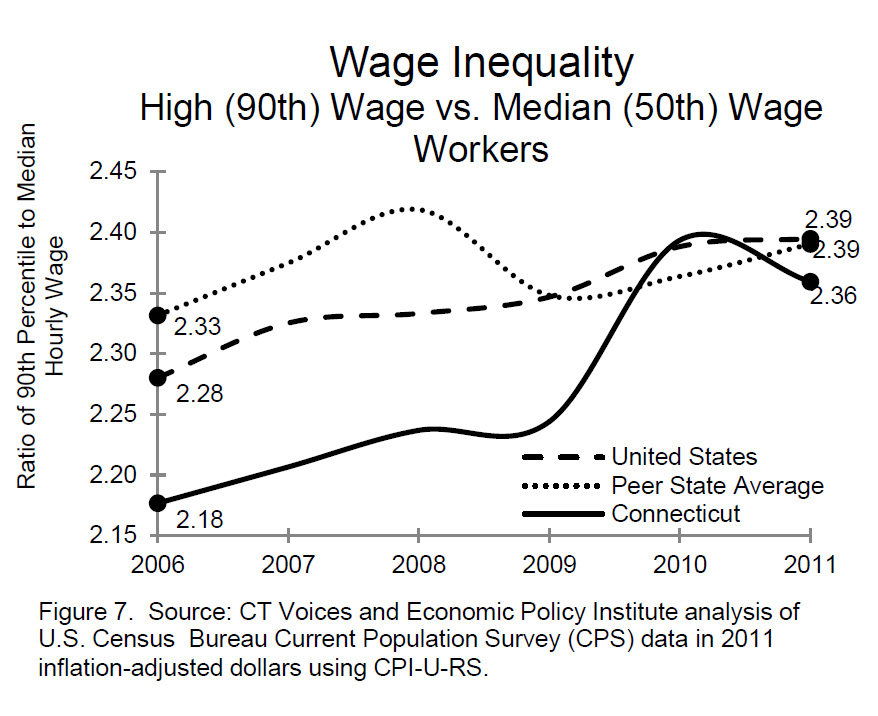
A chart from the report showing how much more high income workers made than the median income level in Conn. (solid line)
While more of Connecticut’s jobs are paying less, there’s also more unemployment at the lower end of the economic spectrum. The unemployment disparities are most pronounced in the study when looking at race and ethnicity in the state. In 2011, more than 17% of Blacks and nearly 18 percent of Hispanics were unemployed, compared to just over 7% of Whites. And age makes a difference. The unemployment for younger people, the 16 to 24 year olds who are out looking for jobs, is over 18 percent, more than double the state average.
Connecticut Voices for Children is using their latest report to urge lawmakers to strengthen the state’s education system, as well as invest in job training programs and raise the state’s minimum wage.
Read the full report here.
Conn. invests in affordable housing in “Gold Coast”
Posted: August 30, 2012 Filed under: Housing Leave a comment »
Lisa Joyner-Kendall washes dishes in her public housing home in Stamford. Joyner-Kendall hopes to soon be able to afford to buy her own home.
A commitment by Connecticut to spend $500 million on affordable housing over the next 10 years might help an affordable housing crunch on the the state’s Gold Coast. Darien has a median home price of more than $1 million, making affordable housing hard to come by. WSHU’s Kaomi Goetz reports a recent groundbreaking at a development in Darien underscores both the need and the difficulty of creating new units. Listen here:

Governor Malloy and other public officials break ground at the Darien housing complex
The 106 rental units and new community center called ‘The Heights of Darien’ are being built with nearly $30 million dollars in federal and state tax credits. The town is also kicking in local support.
One thing the rich and poor in Conn. have in common
Posted: August 28, 2012 Filed under: Politics Leave a comment »Usually on this blog we talk about all the differences between the very rich and very poor in Connecticut. Well, here’s something they have in common – they like Governor Dannel Malloy. Mark Pazniokas of CT Mirror noticed in the latest Quinnipiac University poll that the rich and poor like Malloy better than the people in the middle. He writes, “Voters in households earning less than $30,000 annually approve, 47 percent to 37 percent. He is favored 48 percent to 43 percent by voters with household incomes above $100,000.” He also points out that regardless of income, everybody disapproves of the General Assembly.
Recent Comments