
A lack of mental health services in the middle
Posted: January 9, 2013 Filed under: Health Leave a comment »WSHU’s coverage of disparity issues in Connecticut was necessarily interrupted by coverage the tragic school shooting in Newtown. We plan to share more disparity-related stories soon. In the meantime, there was one story following the Newtown tragedy that raised an issue of disparity. Reporter Melinda Tuhus covered a news conference about mental health services for children, in which Yale professor Steven Marans, Director of the National Center for Children Exposed to Violence, said there was a disparity in the access to mental health coverage for kids.
“The poor have a certain baseline level of services and the wealthy can pay privately, and the middle class has very limited access,” he said.
Here’s Melinda Tuhus’ story:
MT_delaurochildren_121217
It’s an interesting parallel to our recent story about half-day vs. full-day kindergarten. Sometimes the people at the top of the economic spectrum in Connecticut can afford services, those at the bottom get financial assistance, and it’s tough to be stuck in the middle.
Stuck in the middle with… half-day kindergarten
Posted: December 13, 2012 Filed under: Education Leave a comment »
A Torrington, Conn. half-day kindergarten class (photo by Karla Woodworth, contributed by Torrington Early Childhood Collaborative)
The difference between wealthier towns and poorer ones in Connecticut is seen in the educational “achievement gap.” Today, we’re looking at one of the challenges of being in the middle. Specifically, the challenge of funding a full-day kindergarten program. The wealthier towns can afford all day kindergarten because of their tax base. The poorer cities have full-day K because they’re more eligible for grants and state and federal money. But districts like Torrington are stuck in the middle.
Here’s Will Stone’s story:
ws_kdisparity_121213
Most of the attention when we talk about disparity is on the top and bottom. But where else do you see the unique issues of being in the middle? Is your community forgotten, or stuck without resources? Comment here on the blog, or email us at disparity@wshu.org.
Report: More asthma emergency room visits for minority kids
Posted: December 6, 2012 Filed under: Health Leave a comment »
A new report from the Connecticut Department of Public Health says between 2005 and 2009, the number of asthma-related emergency room visits for Hispanic children increased nearly 51%. The report on asthma also says black children had the highest annual rates of hospitalizations because of asthma. Eileen Boulay of the Department of Public Health says they’re trying to determine why so many of these kids wind up going to the hospital.
boulay1_121206
The report says conditions like pollution, inadequate housing, poor health care access and communication, and a lack insurance coverage can contribute to asthma problems. It says in 2011 the state Department of Public Health received funding from the CDC and later from the Affordable Care Act to address chronic disease prevention and health disparities. And it says the department plans to collect more detailed data on chronic diseases like asthma, and they plan to work more closely with health care providers and policy makers on the issue.
A stark economic dividing line: Rowayton & South Norwalk
Posted: December 5, 2012 Filed under: Uncategorized Leave a comment »
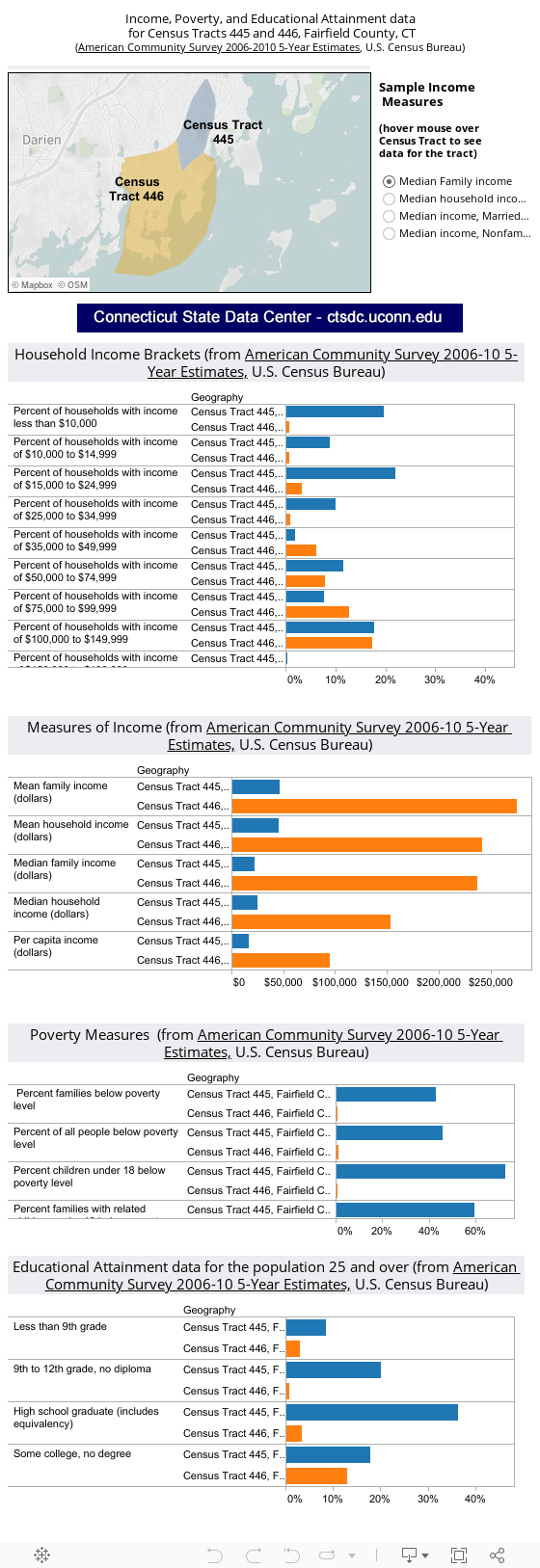
In Connecticut, some very wealthy communities and some low-income neighborhoods are right next to each other. Looking at this map of median household incomes by census tract, some of those borders really jump out. One of the most striking is the difference between Rowayton and South Norwalk. Rowayton’s median household income is $153,036. In South Norwalk it’s $24,661.
WSHU’s Craig LeMoult visited both communities to see how the people there interact with one another. Here’s his story:
lemoult_rowayton_121205_web
Residents of Rowayton and South Norwalk are probably no different than people all over this state – divided into communities that reflect where they stand in the state’s vast economic range. And there’s very little communication across that line.
Here’s an interactive map of the region and some data charts, created by the Connecticut State Data Center at UCONN. Another interactive map is here.
Conn. joins states in trying to address achievement gap with more school hours
Posted: December 3, 2012 Filed under: Education Leave a comment »Connecticut education officials have announced plans to extend school hours in some of the state’s neediest schools beginning next year. The announcement was made today at a forum with U.S. Education Secretary Arne Duncan in Washington. Connecticut, New York, Massachusetts, Colorado and Tennessee will add at least 300 hours of learning a year to some low performing schools. U.S. Education Secretary Duncan says the goal is to boost student achievement in those states. The three year pilot program will affect about 20,000 students in 40 schools in the five states.
Governor Malloy says schools in Hartford, New Haven, Meriden, East Hartford and New London will participate. He says its a natural outgrowth of an education reform law passed by the state in May that included $100 million in new funding to help close the state’s academic achievement gap, one of the worst in the nation.
“The idea that we can tolerate different levels of achievement based on geography or race or wealth or home ownership simply doesn’t make any sense,” said Malloy.
Here’s Ebong Udoma’s story:
eu_extendedschool_121203
Connecticut education commissioner Stefan Pryor says teachers unions are helping make the longer school day happen.”Bridgeport has undertaken a shift method where they are beginning to look at how the teachers can arrive early or later and extend time with limited cost impact,” said Pryor.
Mark Waxenberg of the Connecticut Education Association, the state’s largest teachers union says the important thing is not just adding time for time’s sake. “It’s how to use the time to advance the cause of public education.”
Federal, state and local district money will be used to cover the expanded learning time. The Ford Foundation and the National Center on Time and Learning are also chipping in resources. Here’s their press announcement.
Not everyone agrees that longer school days will make a difference. A report last year from the National School Boards Association’s Center for Public Education disputed the idea that American schools have fallen behind in classroom time. The report said students in high-performing countries like South Korea, Finland and Japan actually spend less time in school than most U.S. students.
Malloy says he hopes national education standard will help with achievement gap
Posted: November 30, 2012 Filed under: Education Leave a comment »Governor Dannel Malloy says he believes the state’s adoption of a new national education standard will help close Connecticut’s achievement gap, which is one of the worst in the country.
The national standards are sponsored by the National Governors Association. The hope is to bring diverse state curricula in alignment with each other. Here’s Ebong Udoma’s story:
eu_standards_121130
Governor Malloy says the inability of public schools in Connecticut to properly prepare 12th grade graduates to compete in college or to have the skills to get a job is “frightening.”
We’re officially launching “State of Disparity”
Posted: November 28, 2012 Filed under: Uncategorized Leave a comment »We’ve been posting some interesting stuff to this blog for a little while now, but it’s time we told people about it! So WSHU Public Radio is happy to be officially launching the “State of Disparity” series and new blog.
Connecticut is home to some of the wealthiest people in the country. It’s also home to some remarkably poor people. The economic disparity in the state is seen in a range of areas – from Connecticut’s educational achievement gap to issues with affordable housing to differences in healthcare availability and health outcomes. Here at on this blog, and in stories on WSHU, we’ll be exploring those issues. We’ll take a look at the different ways that the gap between Connecticut’s rich and poor impacts the state. And we want to hear from you! Please comment on the posts you see here on the blog, and email us at disparity@WSHU.org. We’re also tweeting at @CTdisparity
Here’s WSHU’s Craig LeMoult talking with “Morning Edition” host Tom Kuser about just how much disparity there is in Connecticut, and about the “State of Disparity” project.
lemoult_disparity2way_121129
Below you’ll find several interactive maps that illustrate the scope of economic disparity in Connecticut. There’s also some of WSHU’s coverage of issues on the topic, as well as links to reports and stories from other media outlets. Please check it out, and get back to us with your opinions and your stories.
How does Connecticut’s disparity compare nationally?
Posted: November 28, 2012 Filed under: General 1 Comment »When it comes to incomes, Connecticut has one of the biggest disparities between its richest and poorest citizens. This interactive map was created by the Connecticut State Data Center at the University of Connecticut. Click on each state to see its score in the Gini Index, a scale of disparity.

Incomes across Connecticut: an interactive map
Posted: November 28, 2012 Filed under: Income Leave a comment »This interactive map from the Connecticut State Data Center at the University of Connecticut shows the median household income for every U.S. Census tract in Connecticut. Click on a census tract and a chart below will show the breakout of incomes within that tract.

How much disparity is there in each Conn. town?
Posted: November 28, 2012 Filed under: General Leave a comment »This interactive map, from the Connecticut State Data Center, shows the level of disparity within
each city and town in Connecticut. The measurement is the Gini Index, which is a standard measurement of inequality. A score of 0 would mean the region was completely equal in its distribution of wealth. A score of 1 would mean one person had ALL of the region’s wealth. Note that Greenwich has the widest economic range in the state. The most equal Conn. town is Union.

Recent Comments